Info
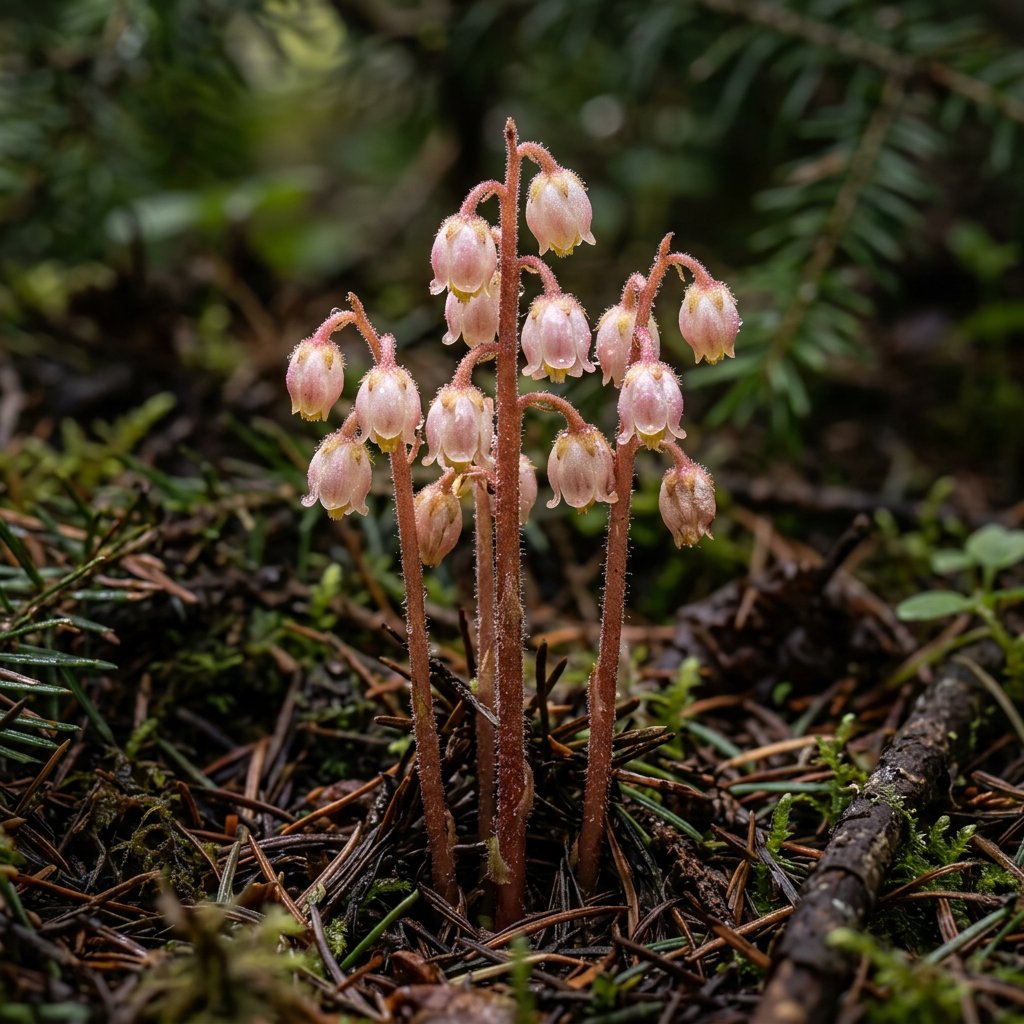
Known as the Pinedrops or "Woodland Pinedrops," this strange and beautiful organism is often mistaken for a mushroom, but it is actually a parasitic plant. Lacking any green chlorophyll to make its own food, it lives a "vampiric" lifestyle, stealing nutrients from underground fungi. In folklore, these tall, scorched-red spikes are sometimes called "ghost pipes of the pines," appearing suddenly on the forest floor like skeletal remains of a summer bloom.
🔍 How to Identify
- 🗼 The Stalk: A tall, unbranched stem that can reach up to 3 feet in height. It is typically reddish-brown or purplish and covered in sticky, glandular hairs that feel tacky to the touch.
- 🔔 The Flowers: Dozens of small, cream-to-yellowish urn-shaped flowers hang downward like tiny bells. They typically bloom in mid-summer along the upper half of the stalk.
- 🍂 The Foliage: You won't find any green leaves here! Instead, the base and stem are covered in small, scale-like bracts, as the plant has no need for photosynthesis.
🌲 Habitat & Ecology
- 🍄 The Hidden Connection: Pinedrops are "mycoheterotrophs." They have a specialized relationship with Rhizopogon fungi (false truffles). The fungi are connected to the roots of Pine or Fir trees, and the Pinedrops tap into this network to steal sugars that the trees produced.
- 🌲 Conifer Companion: You will almost exclusively find them in needle-heavy duff under coniferous trees. They prefer well-shaded, mature forests where the complex underground fungal networks are well-established and undisturbed.
⚠️ Safety & Toxicity
- 🟢 Status: Generally non-toxic.
- 🐾 Details: While not known to be poisonous to humans, dogs, or cats, Pinedrops are not considered edible. Their sticky resin can be difficult to wash off the skin, and because they are rare and have a very specific ecological niche, they should never be harvested or moved.
✨ Fun Fact
Pinedrops are "monotypic," meaning Pterospora andromedea is the only species in its entire genus! It is a lonely survivor of an ancient lineage of plants that decided to give up on sunlight millions of years ago.
More Details