Info
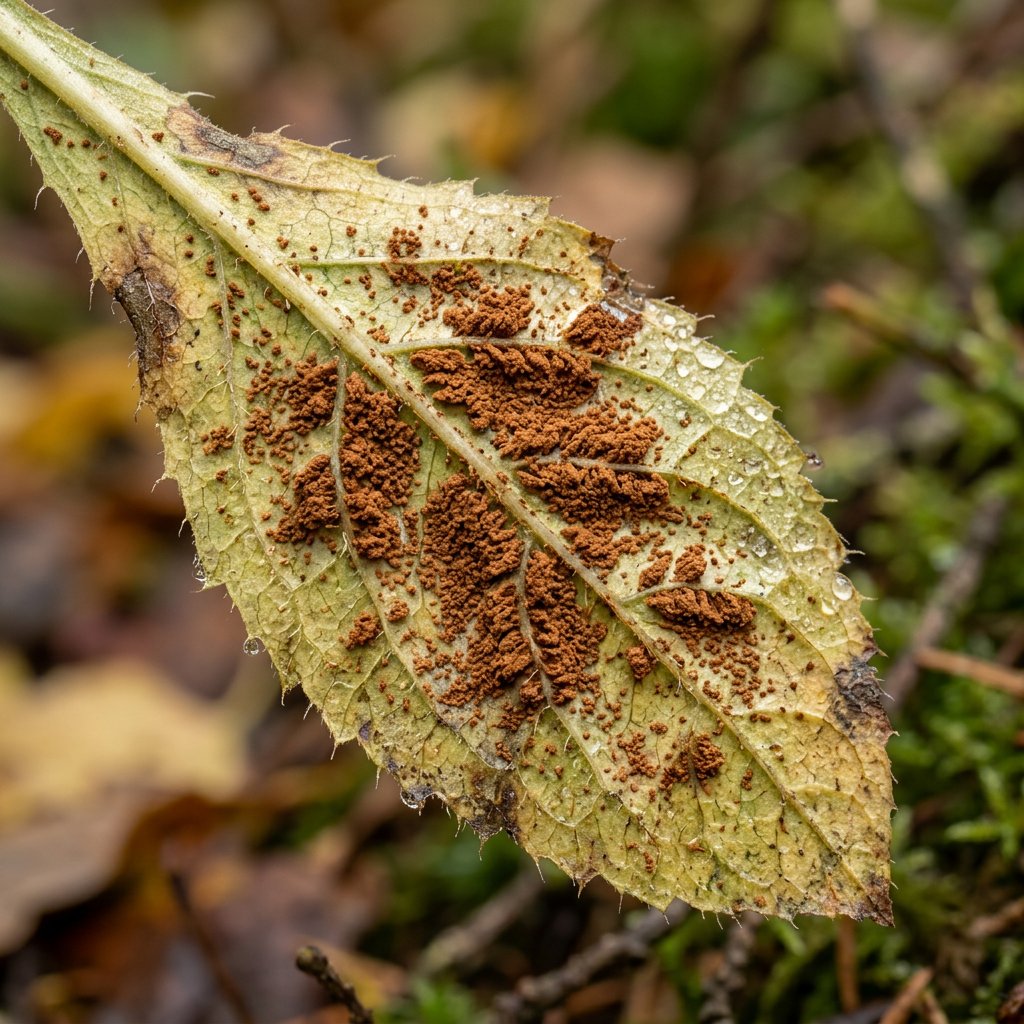
Known as Hawkweed Rust, this fascinating organism belongs to a group of fungi that don't look like your typical "toadstool." Instead of growing a cap and stem, it lives as a colorful, microscopic parasite on the leaves of hawkweeds and dandelions. It is a master of survival, transforming the very cells of its host into "spore factories" to ensure its lineage continues through the wind.
🔍 How to Identify
- 🍂 Rust Pustules: Look for tiny, raised circular bumps (called sori) that break through the leaf's surface, appearing as if the plant has been sprinkled with cinnamon.
- 🎨 Color Shift: In the spring and summer, the spots are a bright rusty-orange; as autumn approaches, they darken to a deep chocolate brown or black.
- 🥀 Host Reaction: Infected leaves often develop yellow "halos" around the rusty spots, and if the infection is heavy, the leaves may curl or wither prematurely.
🌲 Habitat & Ecology
- 🌾 Specialized Diet: This fungus is an "obligate biotroph," meaning it can only survive on living plant tissue. It specifically targets the Hieracium (Hawkweed) genus and occasionally dandelions (Taraxacum).
- 🌬️ Wind Riders: It produces millions of microscopic spores that are light enough to be carried for miles on a light breeze, allowing it to colonize new fields and gardens effortlessly.
⚠️ Safety & Toxicity
- 🚫 WARNING: Puccinia hieracii is a microscopic fungus and is strictly inedible. It does not produce a fleshy fruitbody that can be consumed.
- 🐾 Garden Safety: While it is not toxic to humans or pets if touched, it can be a nuisance for gardeners. It is not "dangerous" in a venomous sense, but it can weaken decorative hawkweeds in your flower beds.
✨ Fun Fact
Rust fungi like Puccinia have some of the most complex life cycles in the natural world, sometimes producing up to five different types of spores in a single year to adapt to changing seasons!
More Details







