Info
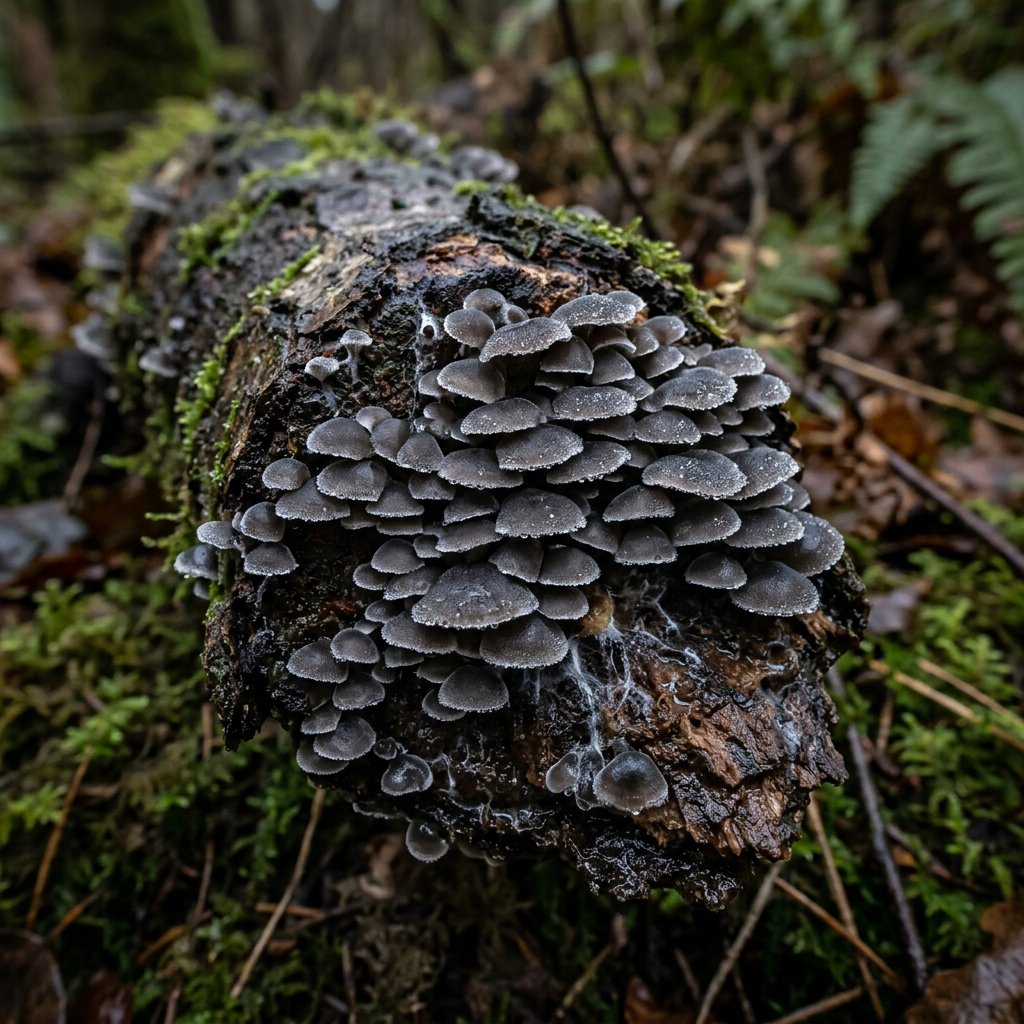
Often referred to as the Smoked Oysterling, these tiny, soot-colored gems are master hide-and-seek players of the forest. They look like miniature, charcoal-stained oyster mushrooms that have decided to grow upside down on the underside of decaying logs. While they may appear delicate, they are hardy decomposers that thrive in the damp, quiet corners of deciduous woodlands.
🔍 How to Identify
- 🍄 The Cap: Small (usually less than 1cm), shell-shaped, and dark gray to blue-black. The surface often has a fine, velvety or fuzzy texture.
- 🌑 The Gills: Radiating from the point of attachment, the gills are grayish and relatively thick for such a tiny mushroom.
- 🪵 Stemless Stature: This mushroom is "sessile," meaning it lacks a stem entirely. It attaches itself directly to the wood, often appearing to "hug" the substrate.
- 💧 Gelatinous Texture: When fresh and moist, the flesh is rubbery or slightly gelatinous, though it becomes tough and inconspicuous when dry.
🌲 Habitat & Ecology
- 🍂 The Wood Recycler: It is a saprobic species, meaning it feeds on dead organic matter. You will almost exclusively find it on the underside of fallen hardwood branches and logs, particularly oak, beech, and maple.
- ❄️ Winter Survivor: Unlike many flashy summer mushrooms, the Smoked Oysterling is often found during the late autumn and even into mild winters, providing a splash of dark color when the rest of the forest is dormant.
⚠️ Safety & Toxicity
- 🚫 WARNING: While not known to be aggressively toxic, Resupinatus applicatus is considered inedible.
- 🧪 Practical Use: Because of its tiny size and tough, rubbery texture, it has no culinary value. As with all wild fungi, never consume any mushroom unless identified with 100% certainty by an expert, as many small dark mushrooms can be easily confused.
✨ Fun Fact
The name Resupinatus comes from the Latin word for "lying on one's back." This refers to the way the mushroom grows with its gills facing outward (downward) while its "back" is pressed against the wood, making it look like it’s taking a nap on a log!
More Details