Info
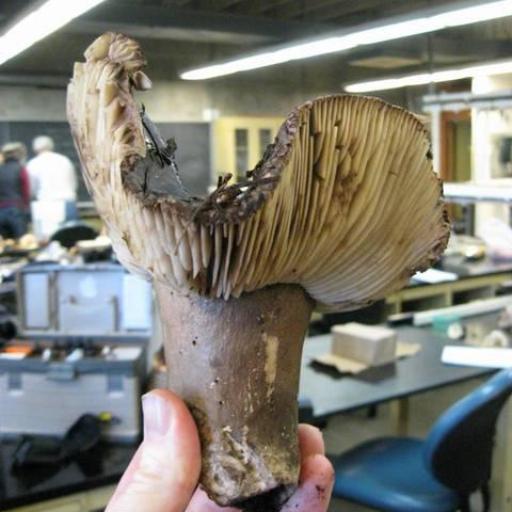
Often called the Winecork Brittlegill, Russula adusta is a mushroom that looks as though it has been salvaged from a campfire. Its name "adusta" comes from the Latin word for "scorched" or "singed," perfectly describing its transformation from a pale, ghostly white to a dark, smoky charcoal as it matures. It is a sturdy, stoic fungus often found hiding under layers of pine needles.
🔍 How to Identify
- 🍄 The Cap: Initially convex and creamy-white, it soon flattens and develops a depressed center, turning a muddy grey-brown or "scorched" blackish color with age.
- 🎨 Bruising Reaction: One of its most distinctive traits; if the white flesh is cut or bruised, it slowly turns a pale pinkish-red before eventually fading to a soot-black.
- 🍷 The Scent: As the mushroom matures, it develops a very specific earthy aroma that many foragers compare to the smell of old wine corks or an empty wine cellar.
🌲 Habitat & Ecology
- 🌲 The Pine Connection: This mushroom is mycorrhizal, meaning it lives in a symbiotic "handshake" with trees. You will almost exclusively find it in coniferous forests, nestled near the roots of Pine and Spruce trees.
- 🍂 Forest Floor Role: It plays a vital role in the ecosystem by helping trees absorb nutrients from the soil in exchange for sugars, helping the forest stay resilient and healthy.
⚠️ Safety & Toxicity
- 🛑 WARNING: While some European traditions list it as edible but "poor," it is generally classified as inedible by modern standards. It is tough, bitter, and known to cause gastrointestinal distress in many people.
- 🚫 Look-alike Risk: It can be easily confused with other "blackening" Russulas, such as the Russula nigricans, which has much thicker, wider-spaced gills. Because of the risk of digestive upset and the difficulty in distinguishing between similar species, it should never be consumed.
✨ Fun Fact
Russula adusta is part of a unique group of mushrooms that can "mummify." Instead of rotting away quickly like most fungi, these mushrooms can remain standing in their blackened, dried-out state for weeks, looking like little pieces of charcoal scattered across the forest floor.
More Details







