Info
Known commonly as the Short-stemmed Russula, this sturdy white mushroom often plays "hide and seek" with foragers. It is a master of disguise, frequently pushing up through the soil and leaf litter to form "shrumps"—small mounds of dirt that hide the mushroom beneath. While it is humble on its own, it is most famous for being the primary host of the parasitic Hypomyces lactifluorum, which transforms this plain white fungus into the vibrant, gourmet "Lobster Mushroom."
🔍 How to Identify
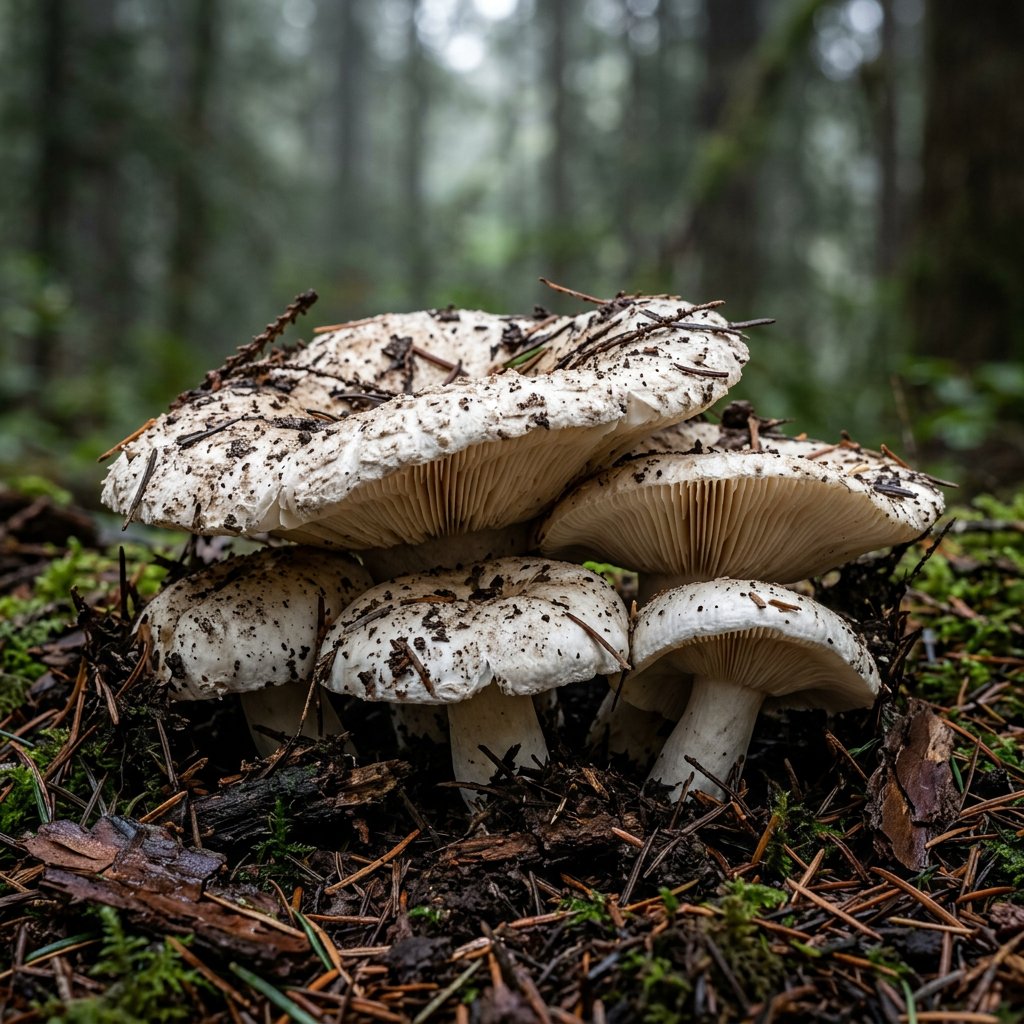
- 🍄 The Cap: Large and fleshy, the cap starts convex but quickly becomes funnel-shaped. It is creamy white but almost always carries a "dirty" appearance from the soil it pushes through.
- ⚪ The Gills: The white to pale-yellow gills are crowded and decurrent, meaning they slightly run down the stem. Unlike Milk Caps, these gills will not bleed "milk" (latex) when sliced.
- 🪵 The Stem: Living up to its name (brevipes meaning "short-footed"), the stem is thick, solid, and exceptionally short compared to the wide cap, often making the mushroom look like it is sitting directly on the ground.
🌲 Habitat & Ecology
- 🌲 Tree Partners: This mushroom is mycorrhizal, meaning it lives in a symbiotic relationship with trees. You’ll typically find it under conifers like Pine or Spruce, as well as some broadleaf trees like Oak.
- 🍂 Forest Janitor: By exchanging nutrients with tree roots, it helps the forest thrive. It is extremely common across North America, appearing in large numbers after summer and autumn rains.
⚠️ Safety & Toxicity
- 🛑 WARNING: While Russula brevipes is considered edible, it is often described as bland, gritty, or slightly acrid. Beginners must be extremely careful not to confuse it with the Short-stemmed White Milkcap (Lactifluus piperatus), which is intensely peppery, or toxic white Amanita species.
- 🤢 Digestive Distress: Some people experience mild stomach upset if it is not cooked thoroughly. Always ensure the specimen is firm and free of maggots, as they are a favorite snack for forest insects.
✨ Fun Fact
The Russula brevipes is the "ugly duckling" of the mushroom world. On its own, it’s a boring white fungus, but when attacked by a specific orange mold, it turns bright red, smells like seafood, and becomes one of the most sought-after wild mushrooms in the world: the Lobster Mushroom!
More Details
| Hymenium Type | Lamella |
| Stipe Character | Bare Stipe |
| Spore Print Color | White |
| Mushroom Cap Shape | Flat Mushroom Cap |
| Hymenium Attachment | Decurrent Hymenium Attachment |
| Mushroom Ecological Type | Mycorrhiza |







