Info
The Russula delica, commonly known as the Milk-white Russula, is a sturdy forest dweller that loves to play hide-and-seek. Often found half-buried under leaf litter, it is a "master of disguise" that looks remarkably like a Milk-cap but lacks the characteristic milky sap. In many cultures, it is nicknamed the "Fool’s Mushroom" because its massive size suggests a feast, while its flavor often leaves much to be desired.
🔍 How to Identify
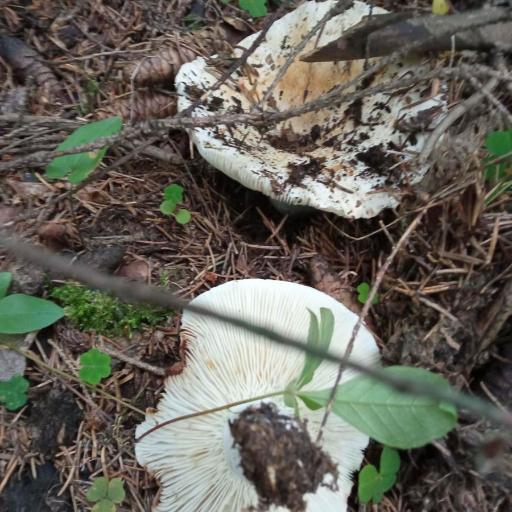
- 🍄 The Cap: Large (up to 20cm), chalky white, and matte. It starts convex but quickly develops a deep, funnel-like depression in the center, often collecting dirt and debris.
- ⚪ The Gills: Narrow, crowded, and slightly decurrent (running down the stem). They are white to pale cream and—crucially—do not bleed "milk" when bruised.
- stub The Stem: Very short, thick, and solid. It is often much narrower than the cap, giving the mushroom a "squat" or top-heavy appearance.
🌲 Habitat & Ecology
- 🍂 Forest Humps: This mushroom is famous for creating "shrumps"—small mounds of soil and leaves that indicate a mushroom is pushing up from beneath. You’ll often have to brush away dirt just to see the cap.
- 🌳 Root Partners: It is ectomycorrhizal, meaning it lives in a symbiotic relationship with trees. It is equally at home in broadleaf forests (Oak and Beech) as it is in coniferous woods (Pine and Spruce).
⚠️ Safety & Toxicity
- 🚨 WARNING: While technically listed as edible in some guides, the Russula delica is generally considered "poor" in quality due to its grainy texture and occasionally acrid (peppery) taste.
- 🚫 Look-alike Risk: It is easily confused with the Lactarius genus (which bleeds milk) and, more dangerously, with some white Amanita species. Never consume this mushroom unless identified by a professional, as white forest mushrooms include the world's most deadly species.
- 🐕 Pet Safety: Like most wild fungi, it can cause severe gastrointestinal distress in dogs and cats if ingested raw.
✨ Fun Fact
The Russula delica is one of the favorite hosts for the Lobster Mushroom parasite (Hypomyces lactifluorum). A parasitic mold attacks the white mushroom, transforming it into a bright orange, crunchy, and delicious "Lobster Mushroom" that actually smells like cooked seafood!
More Details
| Hymenium Type | Lamella |
| Stipe Character | Bare Stipe |
| Spore Print Color | White |
| Mushroom Cap Shape | Convex Mushroom Cap Or Flat Mushroom Cap |
| Hymenium Attachment | Decurrent Hymenium Attachment |
| Mushroom Ecological Type | Mycorrhiza |