Info
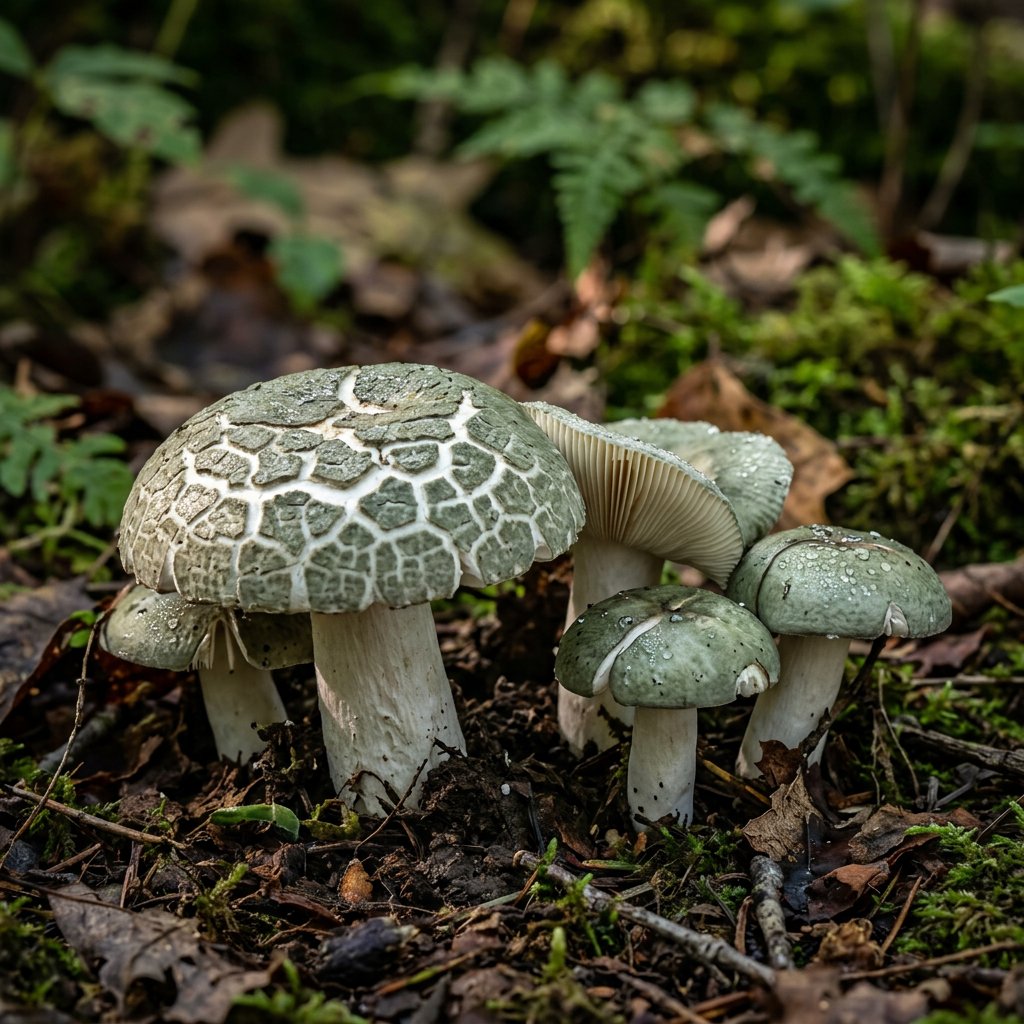
Often called the Blue-Green Cracking Russula, this mushroom looks like a piece of forest porcelain that has shattered and been glued back together. It is celebrated by foragers for its distinct "quilted" appearance and its surprisingly nutty flavor. In many cultures, green mushrooms are viewed with suspicion, but this species is a standout gem of the Eastern North American woods.
🔍 How to Identify
- 🍄 The Cap: The most striking feature; the surface is a pale sea-foam to deep forest green that breaks apart into small, crusty patches as it grows, revealing the white flesh underneath.
- 🤍 The Gills: The gills are creamy white, very crowded, and—true to the Russula family—extremely brittle. They will "shatter" rather than bend if you run your finger across them.
- 🦴 The Stem: The stalk is stout, solid, and pure white. It lacks a ring (annulus) or a cup at the base (volva), and it snaps cleanly like a piece of sidewalk chalk.
🌲 Habitat & Ecology
- 🌳 Hardwood Partner: This mushroom is mycorrhizal, meaning it lives in a symbiotic relationship with trees. It is most commonly found nestled near the roots of Oaks and Beeches in deciduous forests.
- 🍃 Summer Resident: Look for it popping up through leaf litter during the humid months of mid-summer through early autumn, especially after a heavy soaking rain.
⚠️ Safety & Toxicity
- 🛑 WARNING: While Russula parvovirescens is considered a choice edible mushroom, never consume any wild mushroom unless you are 100% certain of its identity.
- 🎭 The Lookalikes: Beginners may confuse green Russulas with the deadly Death Cap (Amanita phalloides). Always check for the presence of a "death cup" (volva) at the base of the stem and a ring on the stalk—features the Russula never has.
- 🤢 The "Nibble" Test: Expert mycologists often use a tiny "spit-and-taste" test (not for beginners!) to rule out "The Sickener" (Russula emetica), which tastes incredibly peppery and causes gastric upset.
✨ Fun Fact
Until 2006, this mushroom was thought to be the same species as the European Russula virescens. DNA testing revealed that the North American version is a distinct species, leading to its new name, parvovirescens, which translates to "small and turning green."
More Details