Info
The Russula rhodocephala, often referred to as a "Red-Capped Russula" or a member of the "Shrimp Russula" group, is a vibrant ruby-red jewel found tucked away on the forest floor. While its brilliant color might suggest a warning in the animal kingdom, in the fungal world, it belongs to a complex group of mushrooms famous for their brittle texture and surprising scents. These mushrooms play a vital role in the forest, acting as underground partners to the trees they grow beneath.
🔍 How to Identify
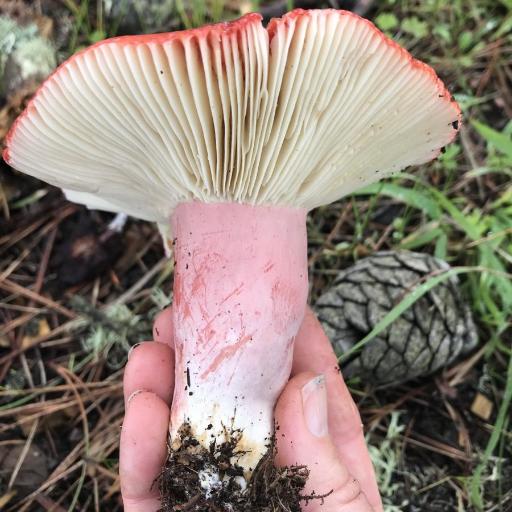
- 🍎 The Cap: A stunning, velvety cap that ranges from deep rose-red to bright scarlet. It typically starts convex and flattens out or becomes slightly sunken in the center as it matures.
- ☁️ The Gills: Close, creamy-white gills that are incredibly brittle. If you run your finger across them, they won't bend—they will snap like delicate pieces of chalk.
- 🥛 The Stem: A stout, solid white stalk that lacks a ring or a veil. In some specimens, the stem may have a very faint, ghostly wash of pink or rose.
- 🦀 The Scent: One of its most famous traits! While young specimens are mild, older mushrooms develop a distinct, savory aroma reminiscent of boiled shrimp or crab.
🌲 Habitat & Ecology
- 🤝 Tree Partners: This mushroom is mycorrhizal, meaning it forms a symbiotic "handshake" with the roots of trees, particularly oaks and pines. It helps the tree absorb water and nutrients in exchange for sugars.
- 🍂 Leaf Litter Lover: You will typically find them emerging from the soil or leaf litter in mixed forests across North America, especially during the humid months of summer and autumn.
⚠️ Safety & Toxicity
- 🚨 WARNING: Identifying red-capped Russulas is notoriously difficult, even for experts. Many species look nearly identical but have very different effects on the body.
- 🤢 The Sickener Look-alike: This mushroom is a "look-alike" to Russula emetica (The Sickener), which causes severe gastrointestinal distress.
- 👅 The Taste Test: Mushroom hunters often use a "nibble and spit" test (where a tiny piece is tasted and immediately spat out) to check for peppiness—if it’s acrid or spicy, it’s toxic. However, for hobbyists, the rule is simple: Do not consume unless identified by a professional mycologist.
✨ Fun Fact
If you apply a drop of iron salts (ferrous sulfate) to the stem of Russula rhodocephala, the flesh will slowly turn a distinct forest green. This chemical "magic trick" is one of the few ways scientists can tell it apart from its many red-capped cousins!
More Details







