Info
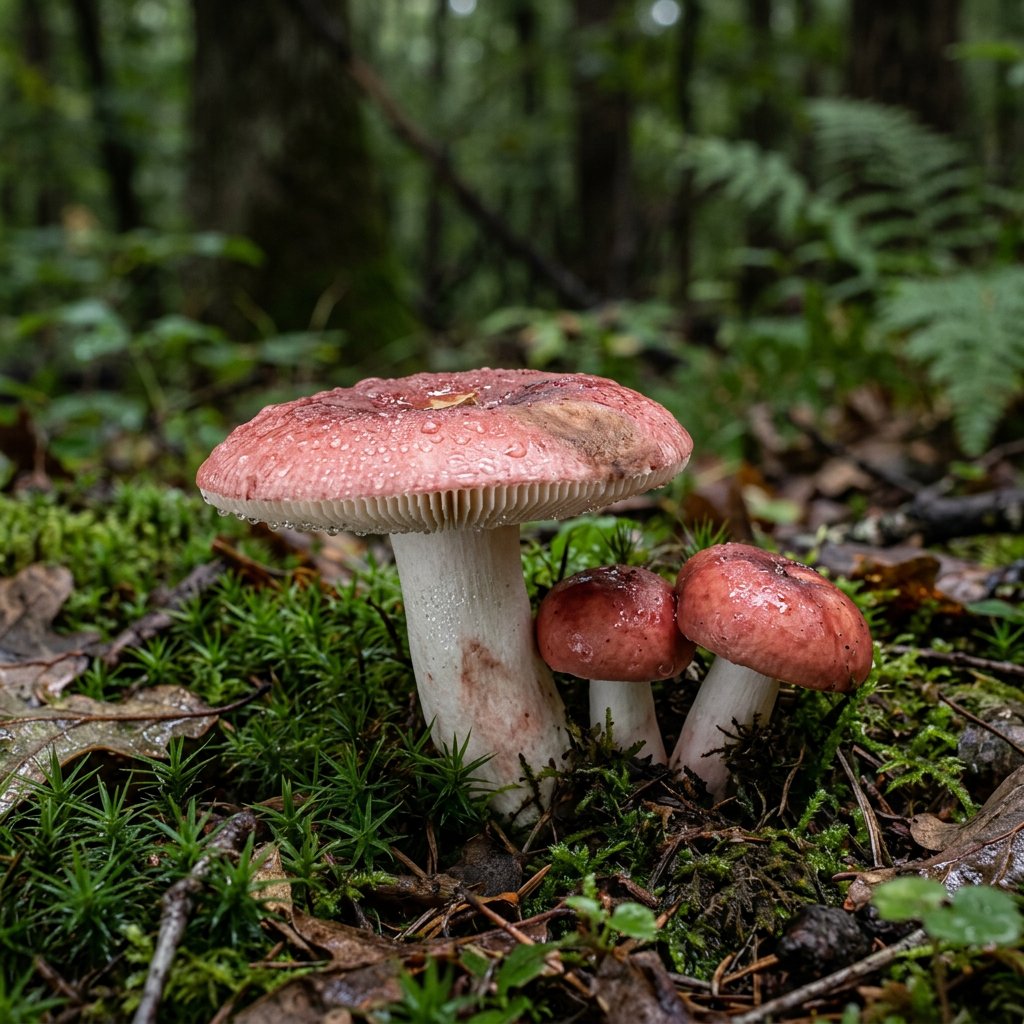
Often called the Blushing Brittlegill, this mushroom is a master of forest theater. While many fungi remain a static color, Russula rubescens reacts to the world around it, performing a slow-motion "blush" from white to rosy-red when its flesh is bruised or sliced. It is a common but delightful find for those exploring the humid hardwood forests during the summer months.
🔍 How to Identify
- 🎨 The Cap: Measuring 2 to 4 inches across, the cap is typically a dull brick-red or pinkish-red. It starts convex but flattens out with age, often developing a shallow dip in the center.
- 🍽️ The Gills: The gills are white to creamy and very brittle. If you run your finger across them, they don't bend—they snap and crumble like dry crackers, a signature trait of the Russula family.
- 🩸 The "Blushing" Stem: The white, stout stem is the key to identification. When bruised or cut, the white flesh slowly turns a distinct reddish-pink before eventually fading to a grimy gray or black over several hours.
🌲 Habitat & Ecology
- 🌳 Tree Symbiosis: This mushroom is mycorrhizal, meaning it lives in a complex, mutually beneficial partnership with tree roots. It is most frequently found hanging out with Oak and Hickory trees.
- 🌦️ Seasonal Timing: While many popular mushrooms wait for the cool autumn air, the Blushing Brittlegill is a fan of the heat. It typically fruits from mid-summer through early fall, especially after heavy rains.
⚠️ Safety & Toxicity
- 🛑 WARNING: Identifying wild Russula species is notoriously difficult, even for experts. Many red-capped species, like the "Sickener" (Russula emetica), are toxic and cause severe stomach upset.
- 🤢 Gastrointestinal Risk: Ingesting lookalike species can lead to intense vomiting and abdominal pain. Because Russula rubescens is part of a complex of very similar-looking mushrooms, it is generally not recommended for consumption by hobbyists.
- 🐾 Pets: Keep curious dogs away; while not usually fatal, wild mushrooms can cause significant distress to a pet's digestive system.
✨ Fun Fact
The "blushing" reaction is actually an oxidative process, similar to how an apple turns brown when sliced. For Russula rubescens, this chemical reaction serves as a biological fingerprint that helps mycologists distinguish it from hundreds of other red-capped lookalikes!
More Details







