Info
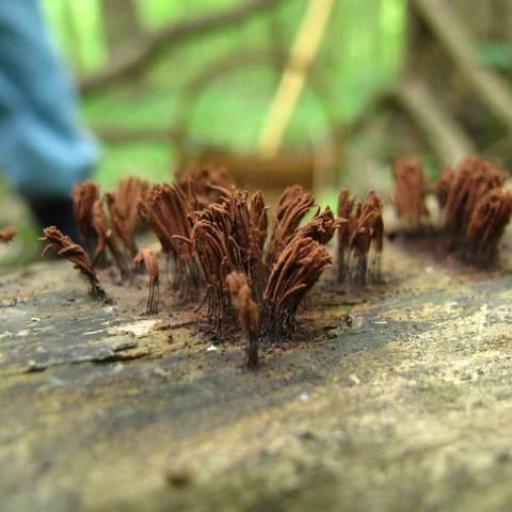
Often called the Chocolate Tube Slime or Tree Hair, Stemonitis splendens is a master of disguise. While it looks like a cluster of delicate brown feathers or tiny cigars, it isn't actually a fungus at all—it is a "slime mold" (myxomycete). This fascinating organism spends most of its life as a single-celled mass that "crawls" across damp wood before transforming into the elegant, upright structures that catch the eye of hikers and gardeners alike.
🔍 How to Identify
- 🍫 The Fruiting Body: Look for tall, slender, cylindrical tubes that range from deep chocolate brown to purplish-black in color.
- 🧵 The Stalk: Each tube is supported by a remarkably thin, shiny black stalk that looks like a strand of stiff hair or a tiny piece of wire.
- 🧺 Growth Habit: They almost always appear in dense, crowded clusters, resembling a miniature, fuzzy forest standing about 1 to 2 centimeters tall.
🌲 Habitat & Ecology
- 🪵 The Substrate: These are decomposers typically found on very wet, decaying logs or rich garden mulch, especially after a period of heavy summer rain.
- 🏃 The "Crawl": Before it takes this tube-like form, the organism exists as a white, jelly-like mass called a plasmodium. It can actually move across the wood (at a microscopic pace) to find the perfect spot to settle and fruit.
⚠️ Safety & Toxicity
- 🛑 WARNING: While Stemonitis splendens is not known to be toxic or poisonous to the touch, it is absolutely not edible.
- 💨 Respiratory Irritant: When the tubes mature, they become a mass of dry, powdery spores. Avoid crushing them or blowing on them, as inhaling the concentrated spores can cause respiratory irritation or allergic reactions in some people.
✨ Fun Fact
Slime molds like Stemonitis are famous in the scientific community for their "biological intelligence." Despite having no brain or nervous system, they can solve complex mazes and recreate efficient transport networks (like the Tokyo subway system) just by seeking out food!
More Details







