Info
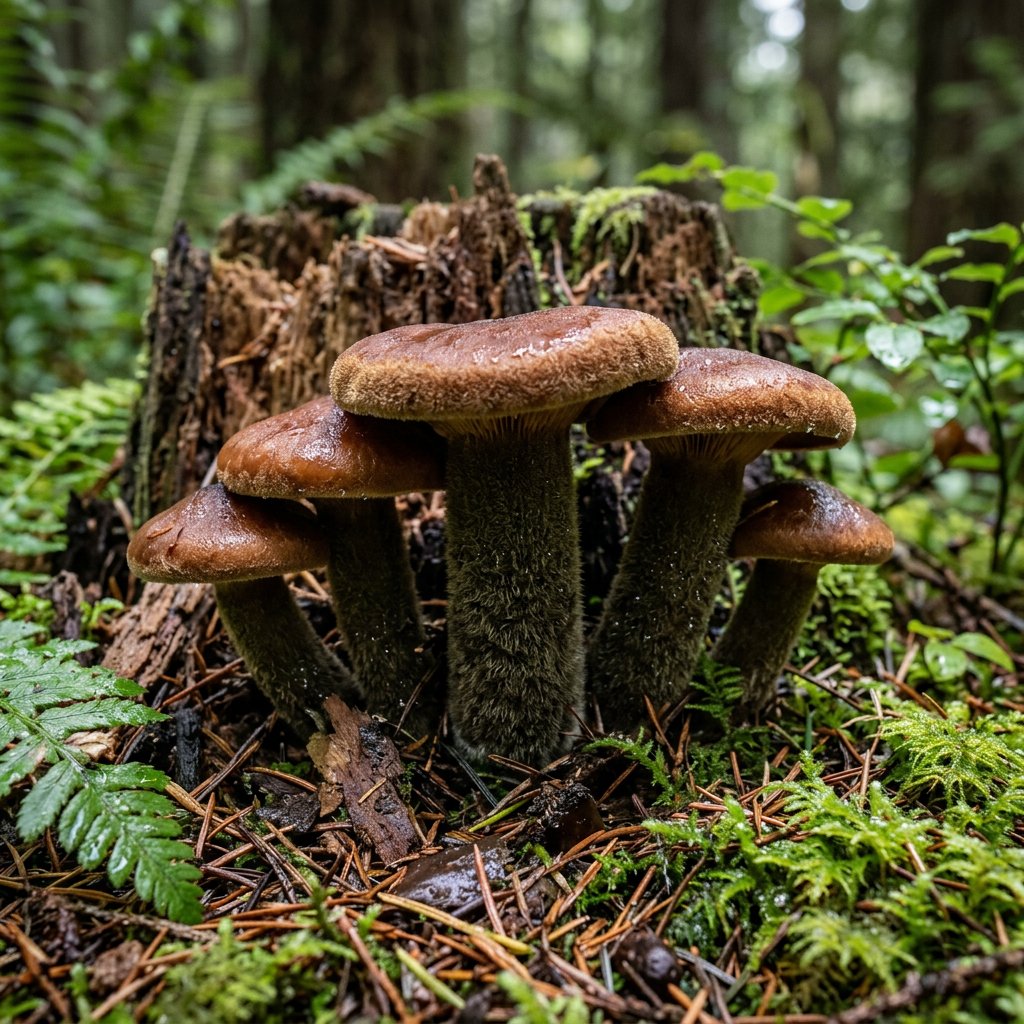
Commonly known as the Velvet-footed Pax, this mushroom looks like it has stepped out of a Victorian novel wearing a pair of plush, dark-brown boots. While its sturdy, suede-like appearance might seem inviting, it is a complex fungus that hides a chemical secret beneath its velvety exterior. It is often found "hugging" the stumps of old pine trees, acting as one of nature’s most efficient recyclers.
🔍 How to Identify
- 🎩 The Cap: Broad and somewhat eccentric, the cap starts out convex but flattens or dips in the center as it ages. It has a dry, felt-like texture and varies from light tan to a deep, rusty brown.
- 📜 The Gills: The yellowish-buff gills are "decurrent," meaning they run slightly down the stem. They are crowded and often wavy, bruising a brownish color if handled roughly.
- 👞 The Stem: This is the most distinctive feature. The stem is thick, often off-center, and covered in a dense, dark brown to blackish "velvet" (tomentum) that feels like soft fabric to the touch.
🌲 Habitat & Ecology
- 🌲 The Conifer Connection: You will almost exclusively find this mushroom growing on or near the decaying stumps and buried roots of coniferous trees, particularly pines and spruces.
- 🍂 Woodland Recycler: As a saprobic fungus, it plays a vital role in the forest ecosystem by breaking down tough cellulose and lignin in dead wood, turning old stumps back into nutrient-rich soil.
⚠️ Safety & Toxicity
- 🚫 Status: WARNING! TOXIC/INEDIBLE.
- 🤢 The Risk: While not as deadly as its infamous relative, the Brown Roll-rim (Paxillus involutus), the Velvet-footed Pax causes severe gastrointestinal distress. Symptoms include nausea, vomiting, and stomach cramps.
- 🔬 Chemical Concern: It contains certain compounds that may have long-term cumulative effects on the body. It should never be consumed, even if older foraging guides suggest otherwise.
✨ Fun Fact
Natural dyers absolutely love this mushroom! Despite its brown appearance, the chemicals inside (atromentin) can be used to dye wool and silk into beautiful shades of purple, blue, or green, depending on the pH of the dye bath.
More Details







