Info
Known as the "Yellow Knight" or "Man on Horseback," this mushroom was once the toast of French banquets, traditionally reserved for the nobility while commoners ate less "noble" fungi. Its stunning golden-yellow hue makes it a standout on the forest floor, but its reputation has undergone a dramatic and dangerous fall from grace in recent decades. Once considered a choice edible, it is now viewed with extreme caution by mycologists worldwide.
🔍 How to Identify
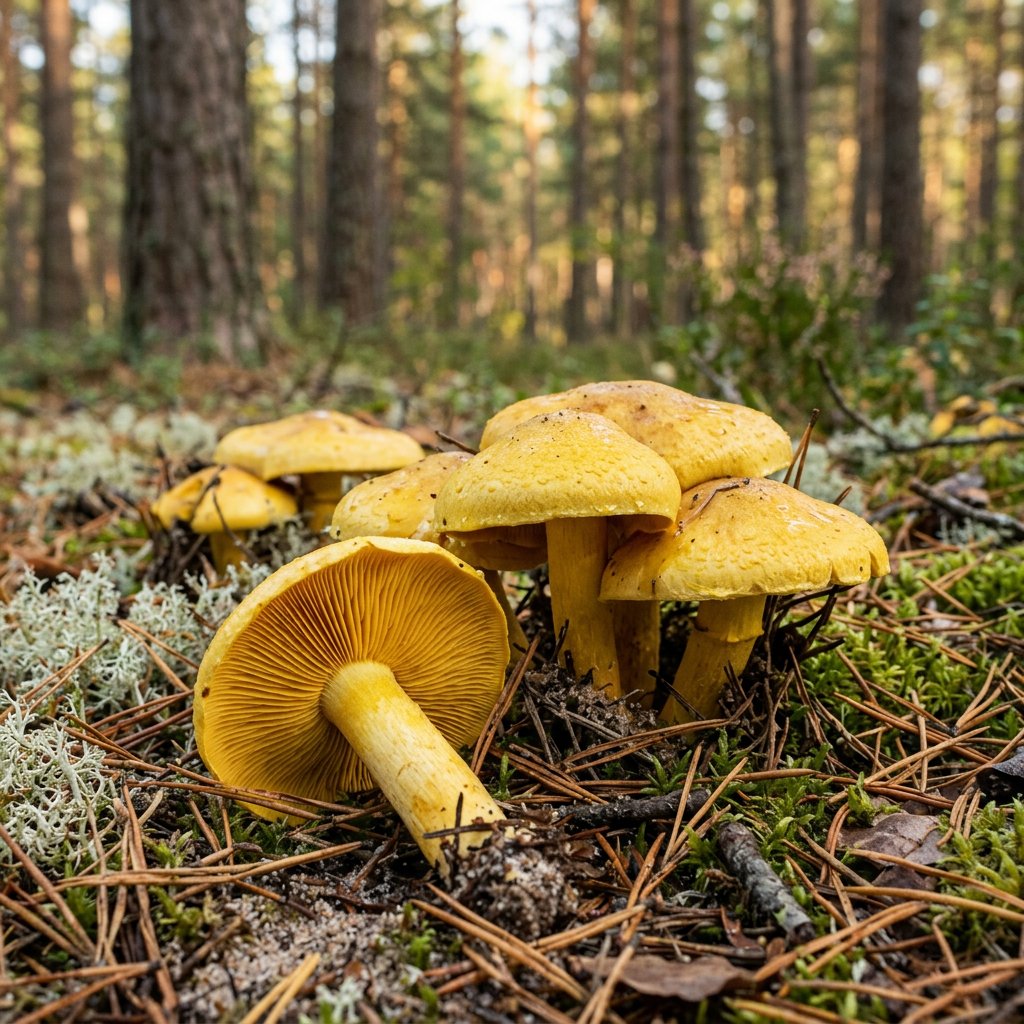
- 🍄 The Cap: Measuring 5–12 cm, the cap is a vibrant sulfur-yellow to olive-yellow. It is often slightly sticky or "viscid" when damp and may have tiny, brownish scales toward the center.
- 🌞 The Gills: Underneath, you’ll find crowded, bright yellow gills that stay yellow even as the mushroom ages. They are "sinuate," meaning they curve slightly upward before reaching the stem.
- 🌲 The Stem: The stalk is thick, solid, and typically a matching pale yellow. Because it grows in soft ground, the stem is often buried deep in the substrate, making the mushroom look shorter than it actually is.
🌲 Habitat & Ecology
- 🏖️ Sandy Preferences: This species has a very specific love for sandy, acidic soil. If you are walking through a coastal pine forest or a sandy inland woodland, keep your eyes peeled near the base of trees.
- 🤝 Pine Partnerships: It forms a mycorrhizal (symbiotic) relationship primarily with pine trees. It helps the trees absorb nutrients while the tree provides the mushroom with sugars, usually appearing in late autumn or early winter.
⚠️ Safety & Toxicity
- 🛑 WARNING: Potentially Lethal. While historically eaten for centuries, Tricholoma equestre is now classified as toxic and dangerous.
- 🤒 Muscle Breakdown: Recent medical reports have linked the consumption of this mushroom to "rhabdomyolysis," a severe condition where muscle tissues break down rapidly. This can lead to kidney failure and, in several documented cases, death. Because there is no way to know an individual's sensitivity, it should be treated as a poisonous species and never consumed.
✨ Fun Fact
- ⚔️ The Noble Fungus: The species name equestre comes from the Latin word for "knight." In medieval France, it was believed that this mushroom was so refined that it was the only fungus fit for those of noble birth who rode on horseback.
More Details
| Hymenium Type | Lamella |
| Stipe Character | Bare Stipe |
| Spore Print Color | White |
| Mushroom Cap Shape | Flat Mushroom Cap |
| Hymenium Attachment | Adnexed Hymenium Attachment |
| Mushroom Ecological Type | Mycorrhiza |







