Info
Often called the American Matsutake, this mushroom is the North American cousin of the legendary Japanese delicacy. It is famous for its powerful, spicy aroma—often described as a mix of cinnamon-scented "red hots" and old gym socks—and its firm, meaty texture. In many cultures, finding a "Pine Mushroom" is considered a stroke of incredible luck and a herald of the autumn season.
🔍 How to Identify
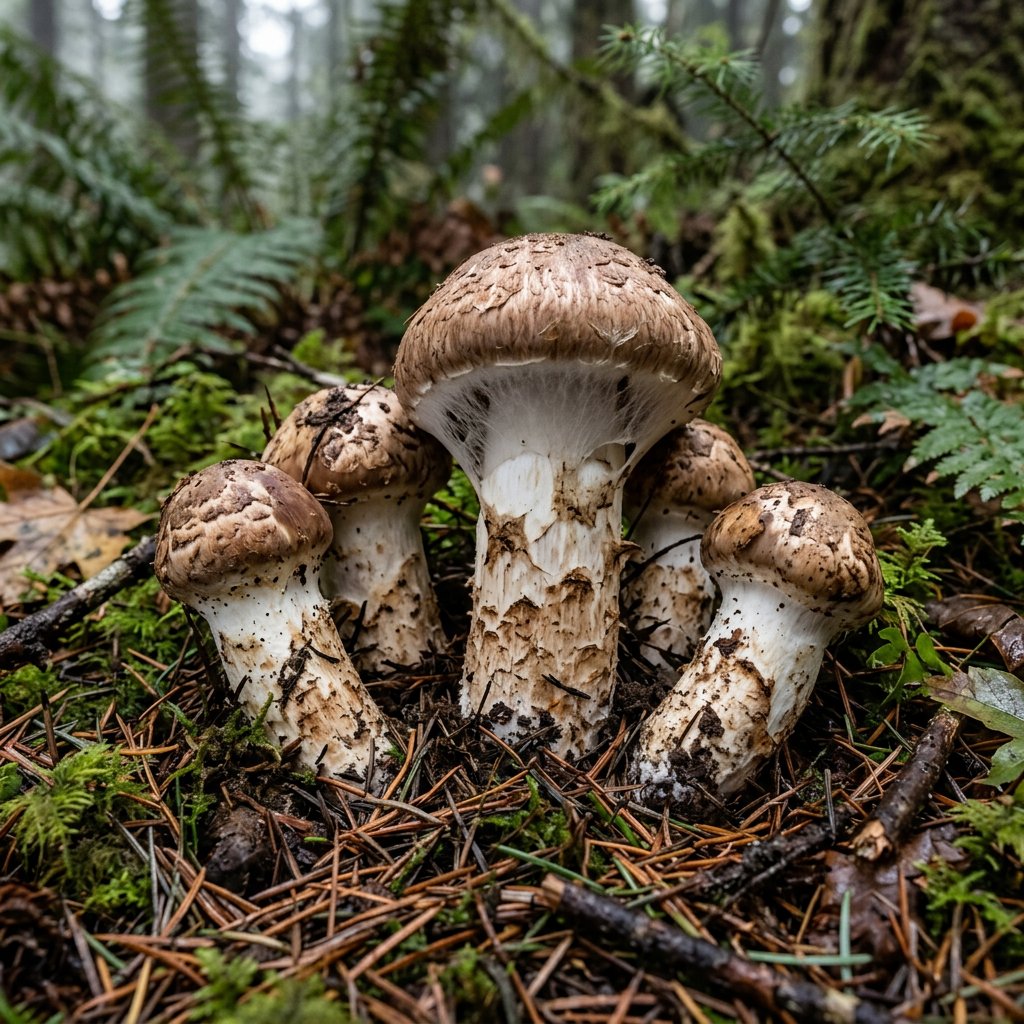
- 🍄 The Cap: Starts as a white, rounded button and expands into a broad, flat top. It is typically white but develops brownish, fiber-like scales as it matures.
- ⚪ The Gills: The gills are crowded, white, and "attached" to the stem. Unlike some other white mushrooms, they do not turn yellow or brown quickly when bruised.
- 🧣 The Veil & Stem: A thick, cottony ring (the "magnivelare" or large veil) stays around the sturdy, white stem. The stem is solid, never hollow, and usually tapers toward the base.
🌲 Habitat & Ecology
- 🌲 Tree Partners: This mushroom is mycorrhizal, meaning it lives in a symbiotic "handshake" with trees. It is most commonly found under Pine, Fir, and Hemlock, particularly in sandy soils.
- 🍂 The "Shrump": Because they are heavy and dense, they often struggle to break through the forest floor. Look for "shrumps"—mysterious bumps in the pine needles or moss that signal a mushroom is pushing up from below.
⚠️ Safety & Toxicity
- ⚠️ WARNING: While Tricholoma magnivelare is a choice edible, it has dangerous "look-alikes." Never consume any mushroom unless you are 100% certain of its identity.
- 🚫 Deadly Look-alikes: It can be confused with certain white Amanita species (like the Destroying Angel), which are deadly. Always check the base of the stem; Matsutake stems are solid and tapered, whereas Amanitas have a "volva" or cup-like structure at the very bottom.
- 👃 The Scent Test: The unmistakable spicy, pungent odor is the best way to confirm you have a Matsutake. If it smells like flour or has no scent, it is likely a different, potentially toxic species.
✨ Fun Fact
In Japan, the Matsutake is a symbol of longevity and is considered a high-status gift. The finest specimens are often presented in elaborate wooden boxes lined with fresh pine needles and can sell for hundreds of dollars per pound.
More Details







