Info
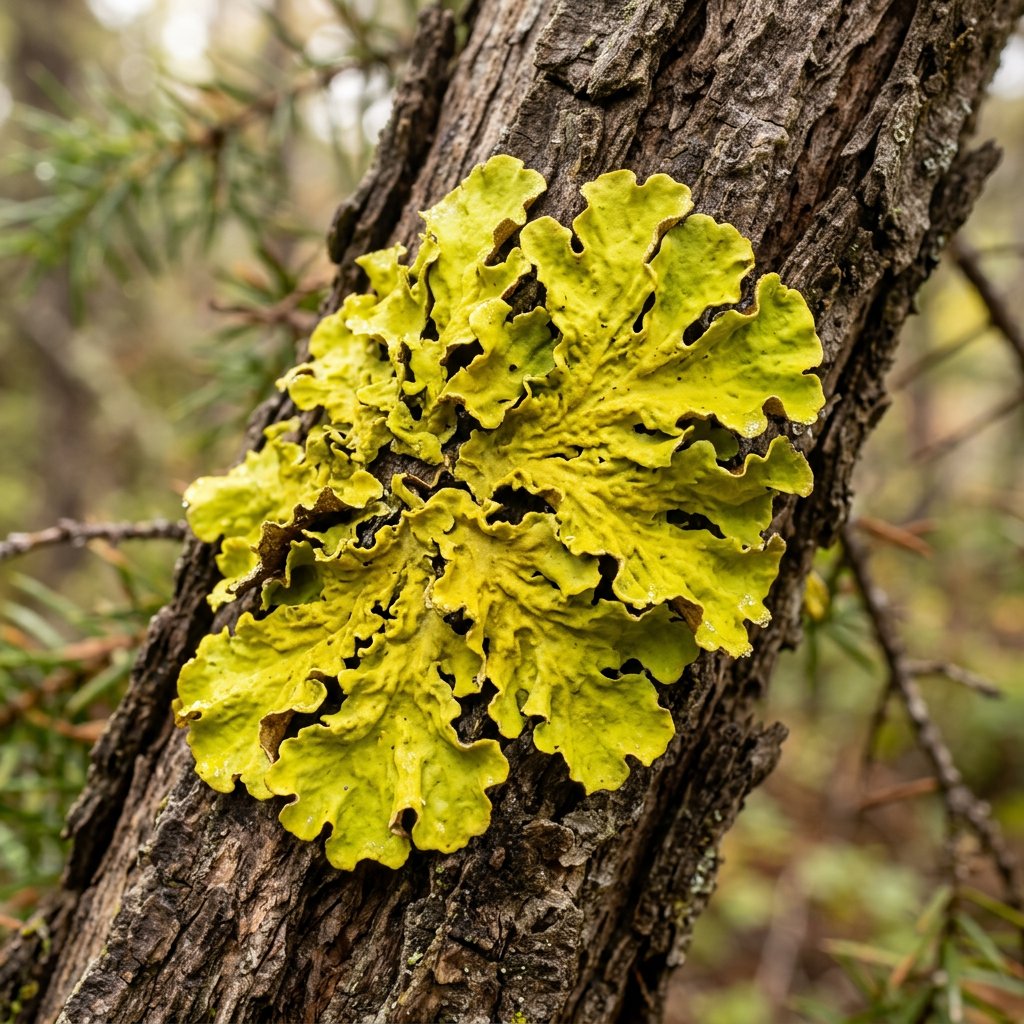
Known as the Juniper Gold-moss or the Juniper Fox-killer, this striking lichen is a member of the Fungi kingdom that chooses a vibrant life on the bark of conifer trees. Its name sounds like something out of a medieval herbarium, and for good reason—its neon-yellow color was once a warning to predators and a tool for hunters in the deep forests of Northern Europe.
🔍 How to Identify
- 💛 The Thallus: This lichen is "foliose," meaning it looks like tiny, ruffled leaves. Its color is a brilliant, almost artificial-looking chartreuse or sulfur-yellow.
- 🌲 The Host: As the name suggests, it is most commonly found hugging the branches and trunks of Juniper trees, though it occasionally wanders onto other conifers or even sun-bleached wood.
- 🧪 The Texture: The edges of the "leaves" are often crinkled and may feature small, dark fruiting bodies (apothecia) that look like tiny brown disks tucked into the yellow folds.
🌲 Habitat & Ecology
- 🏔️ High-Altitude Specialist: You’ll typically find this species in subarctic or alpine environments where air quality is pristine. It is highly sensitive to pollution, making it a "canary in the coal mine" for forest health.
- 🤝 The Symbiotic Life: Like all lichens, it isn’t a single organism but a partnership between a fungus and an alga. The fungus provides the structure and protection, while the alga produces food through photosynthesis.
⚠️ Safety & Toxicity
- 🚫 WARNING: Highly Toxic if Ingested. While it may look like a beautiful decorative moss, it contains vulpinic acid, a potent metabolic poison.
- 🦊 Historical Risk: Historically, this lichen was ground up and mixed with reindeer fat and glass to create poison bait for wolves and foxes in Scandinavia.
- 🐾 Pet & Child Safety: Keep away from curious pets and children. Ingestion can lead to severe internal distress and, in high enough concentrations, can be fatal to small mammals.
✨ Fun Fact
The genus name Vulpicida literally translates from Latin as "Fox-killer." It is one of the few organisms in the world that produces vulpinic acid in such high concentrations that it can effectively deter almost all herbivores from taking a bite!
More Details







