Info
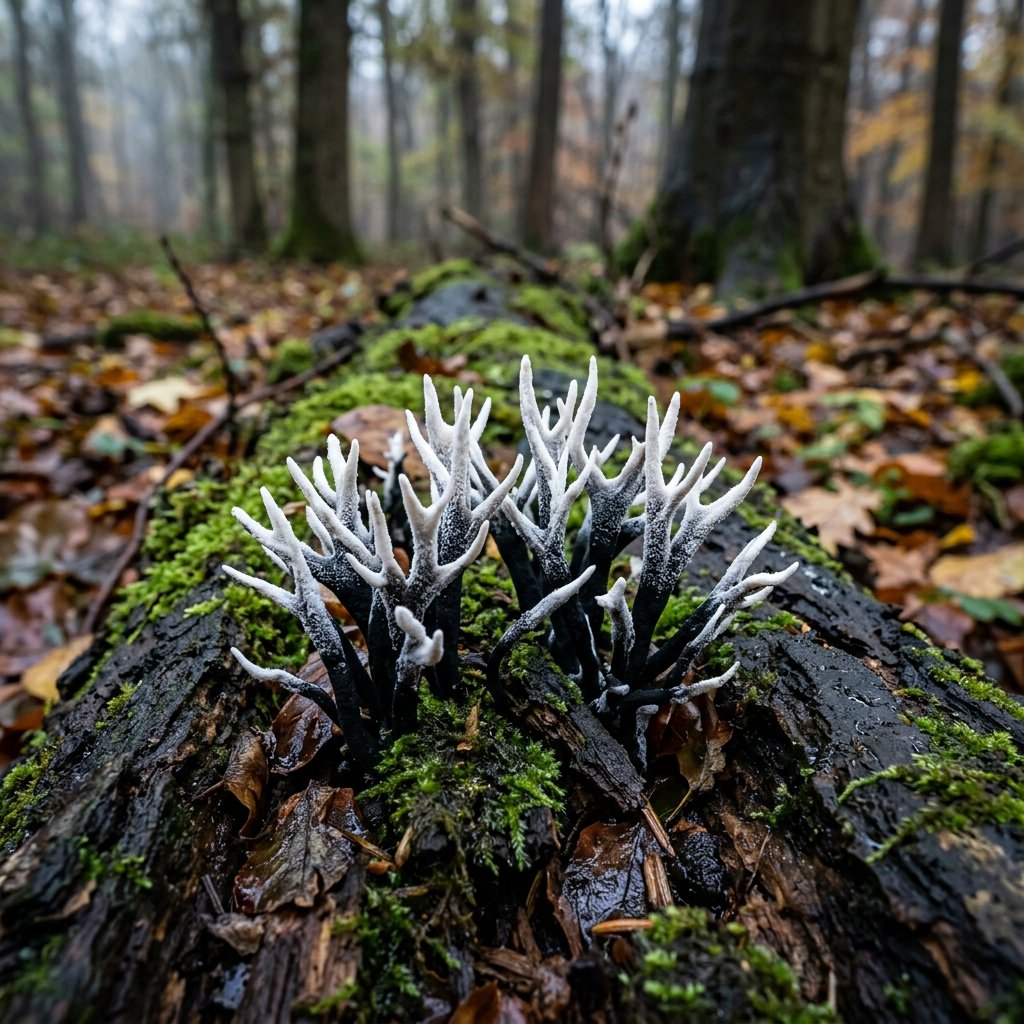
Known as the "Candlesnuff Fungus" or "Stag’s Horn," this eerie mushroom looks like the charred remains of a tiny campfire or a set of miniature, ghostly antlers. It thrives in the shadows of the forest floor, appearing as if its tips were dipped in white ash or flour. In folklore, these were often thought to be the charred fingers of forest spirits reaching out from decaying logs to reclaim the earth.
🔍 How to Identify
- 🦌 Antler-like Shape: The fruiting body usually branches at the top, closely resembling the antlers of a deer or a stag.
- 🌑 Contrast Coloring: the base is charcoal black and velvety, while the upper branches are covered in a powdery white "dust" (asexual spores) during the spring and summer.
- 🧤 Tough Texture: Unlike soft, fleshy mushrooms that crumble, this fungus is tough, woody, and flexible—almost like a piece of sturdy rubber or charcoal.
🌲 Habitat & Ecology
- 🪵 Woodland Recycler: You will almost always find it growing in clusters on decaying broadleaf wood, especially old beech, oak, or stump remains. It is a "saprobic" fungus, meaning it does the heavy lifting of breaking down tough wood fibers to return nutrients to the soil.
- 🌧️ Year-Round Resident: While the striking white tips are most prominent in the spring, the blackened, "burnt" stalks of the fungus are remarkably hardy and can be spotted throughout the autumn and even deep into winter.
⚠️ Safety & Toxicity
- 🚫 WARNING: Never consume wild mushrooms without expert in-person identification.
- 🦷 Inedible Status: While not famously "deadly" in the way some mushrooms are, the Candlesnuff Fungus is considered entirely inedible. Its consistency is cork-like and woody; attempting to eat it would be like chewing on a piece of bitter, carbonized wood.
- 🐾 Pet Safety: While it doesn't typically attract pets, its tough, fibrous structure can cause digestive upset or blockages if swallowed by a curious dog.
✨ Fun Fact
The name "Candlesnuff" comes from the visual similarity to a candle wick that has just been extinguished, leaving behind a white, smoky tip. Interestingly, because it is so rich in carbon, it was historically studied for its potential to produce "bioluminescence," though it is the white spores—not a literal light—that make it "glow" in the dim forest twilight.
More Details







